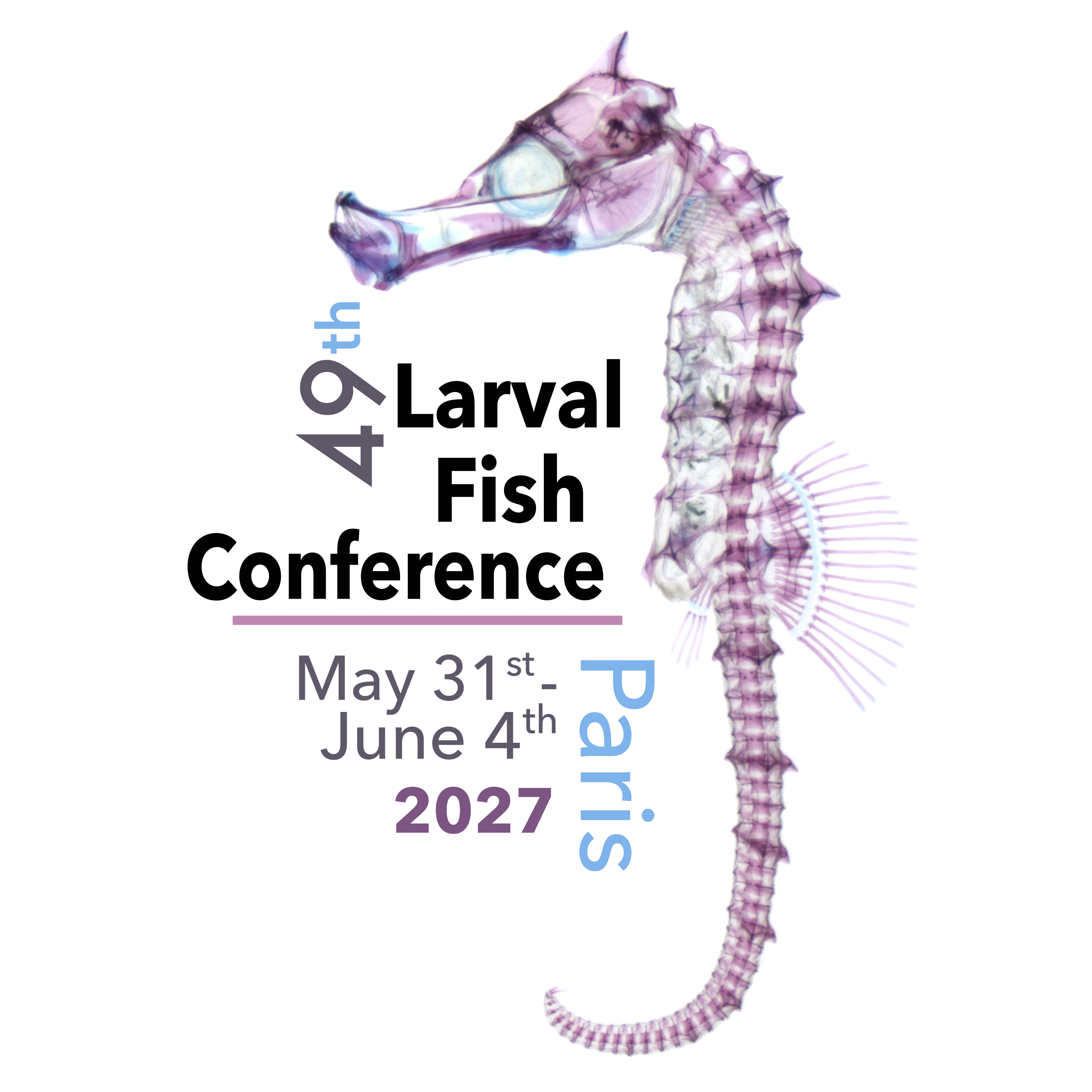
Confirmed topical sessions
Effects of global change on early life stages of fish
Fish eggs and larvae are particularly sensitive to environmental conditions, and changes during these early developmental stages can affect their growth, development, survival and behaviour. This topical session will explore how global change affects early life history stages and welcomes contributions dealing with:
• Consequences of ocean acidification, deoxygenation and other environmental stressors for recruitment, population dynamics, species distributions and dispersal
• Effects of ocean warming and marine heat waves on eggs and larvae
• Responses of early life stages to multiple and interacting stressors
Drivers of recruitment variability: environmental effects on feeding, growth, and first-year survival
During the first year of life, larval and juvenile stages of fish undergo a series of critical periods characterized by high mortality rates with possible effects on recruitment strength. Recent research indicates that the relationship between environmental drivers and vital rates is highly variable among species and in some cases, among populations. It is thus important to move beyond the general theory and gain a detailed understanding of early life dynamics at the ecosystem and/or population level in order to gain a mechanistic understanding of how recruitment is regulated. This topical session welcomes contributions dealing with:
• Larval and juvenile feeding ecology and growth dynamics
• The timing of critical periods for survival
• Spatiotemporal, intraspecific and/or interspecific variability in larval growth-survival dynamics
• Drivers of variability in mortality, including predation as well as other biotic and abiotic factors
Revealing fish diversity through their early life stages: Identification, Taxonomy, Morphology and Biodiversity
The identification of fish eggs and larvae remains a major challenge in documenting biodiversity and understanding the ecology of early life stages. This session will explore how morphological descriptions, developmental series, DNA barcoding and integrative taxonomy can improve species identification and reveal previously unrecognized diversity. This topical session welcomes contributions dealing with:
- Morphological descriptions and characterization of early life stages
- Linking larval and adult stages
- Developing identification keys
- Establishing reference collections
- Building DNA sequence libraries
Studies of early life stages in support of fisheries and aquaculture
The importance of larval survival has been identified as a critical bottleneck to the recruitment of exploited wild stocks as well as to aquaculture production more than 100 years ago. Today, a wide range of topics are the object of active research in support to fisheries and aquaculture. This session welcomes contributions dealing with:
• Reproduction and egg quality including parental effects
• Feeding and nutrition of larvae and juveniles
• Disease, immunity and microbiomes
• Larval and juvenile surveys in support to stock assessment
• Novel rearing techniques
Evolutionary developmental biology of early life stages of fish
Contributed papers: Any other contribution of high quality not fitting the above-mentioned sessions will be considered herey of larval fish
Convening Committee
Fabrice Teletchea – Université de Lorraine
Clara Lord – Muséum National d’Histoire Naturelle
Nalani Schnell – Muséum National d’Histoire Naturelle
Romain Causse – Muséum National d’Histoire Naturelle
Dominique Robert – Université du Québec à Rimouski


